Meet the New York City chefs who kept Ground Zero workers fueled after the 9/11 attacks

Daftar Isi
New York Chefs Built a Floating Food Operation for Ground Zero Workers
Tyunews.com – In the aftermath of the Sept. 11, 2001 attacks, a group of New York City chefs, caterers and food-service workers found a practical way to help: they organized an around-the-clock meal operation for the people working at Ground Zero.
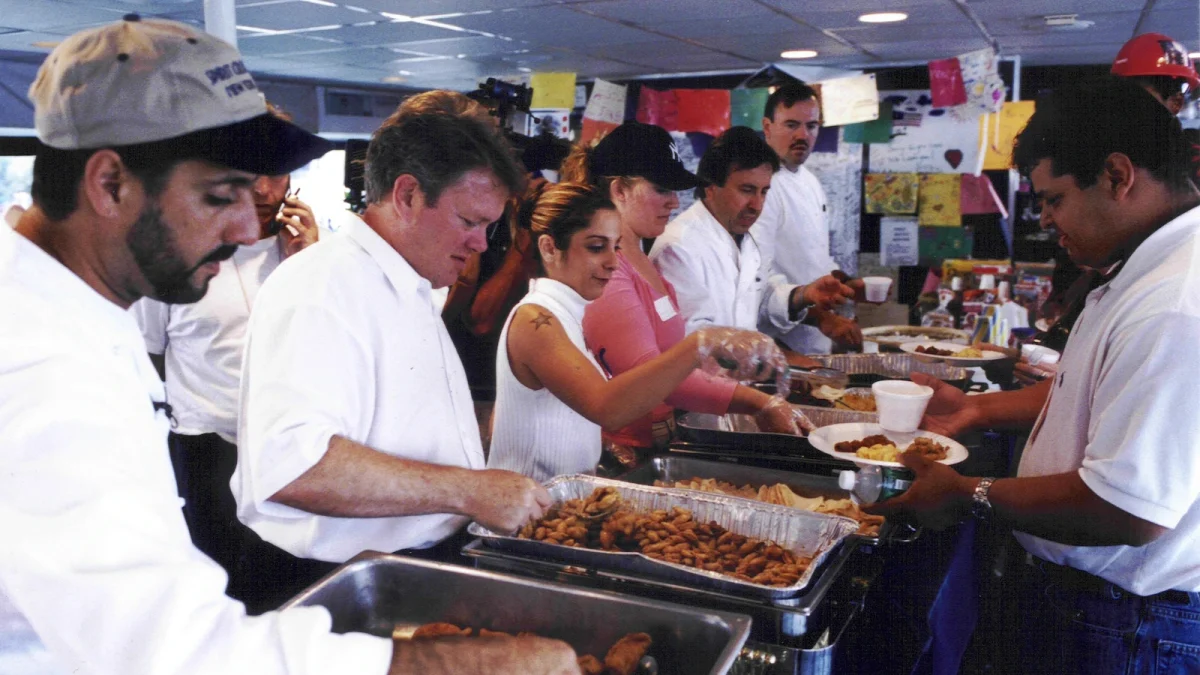
For two months, volunteers in what became known as Operation Chefs with Spirit prepared, transported and served food to recovery workers. The effort relied on restaurant expertise, donations, quick coordination and an unusual delivery route: boats on the Hudson River.
Chef Don Pintabona, now 66, had spent years creating high-end food for guests at Tribeca Grill, including celebrities, Wall Street professionals and other prominent diners. But the scale and urgency of the work after the destruction of the World Trade Center was unlike anything he had encountered in a restaurant kitchen.
A Need to Help Takes Shape
On Sept. 11, Pintabona watched the towers’ destruction from the roof of his Brooklyn home. The site was close enough that debris, including loose paper from the buildings, drifted through the air nearby.
One page that reached him was from the dictionary’s “P” section. Pintabona noticed a contrast in the words printed on it: some carried negative associations, while others included “persevere,” “perseverance” and “persistence.” The page became a personal reminder of how he wanted to respond to the disaster.
“I mean, in my mind, this came straight from heaven, that through the perversion, you gotta persist, you gotta persevere,” he said. “So those words were banging around my head for the days and weeks and just trying to figure out how can I live up to this.”
The next day, he reached his restaurant and began cooking with the ingredients already in the kitchen. He brought the food to Stuyvesant High School in lower Manhattan, one of the locations being used to support first responders.
The demand was immediate. People poured in for meals, and the available food disappeared within hours. The experience confirmed that feeding workers could make a meaningful difference, but it also exposed a central logistical problem: much of lower Manhattan had damaged streets and limited access, with routes largely restricted to first responders and the National Guard.
The Hudson River Becomes a Supply Route
Pintabona’s answer came while he stood near the Hudson River during a cigarette break and saw a barge. Instead of trying to force food deliveries through blocked streets, he realized the waterfront offered a way around them.
“I saw a barge…And I said, ‘Holy s—, this is it. We’ve got to feed everybody by boat,’” he recalled.
That realization became the foundation for a large-scale, water-based operation. Pintabona connected with other chefs who also wanted to contribute, then began reaching out across the food industry, city government and the cruise business. The owner of Spirit Cruises, a company known for sightseeing and party cruises in the city, became part of the rapidly developing plan.
Spirit supplied three vessels with distinct roles. One boat at Chelsea Piers functioned as the place where meals were cooked and assembled. A second carried the completed food to Ground Zero. A third, a triple-decker boat positioned in Battery Park City near the recovery site, gave workers a place to eat and rest.
The arrangement turned the river into a working food corridor at a time when conventional delivery systems were constrained. It also allowed cooks, servers and volunteers to use skills they already knew well: preparing meals in volume, organizing supplies, coordinating service and keeping a kitchen moving under pressure.
Restaurant Community Mobilizes
Operation Chefs with Spirit brought together people from across New York’s restaurant world. Well-known chefs including Charlie Palmer, Danny Meyer and Daniel Boulud joined food workers and volunteers in the effort. Their responsibilities ranged from preparing vegetables to sorting forks, spoons and plates.
The operation’s success depended on many small tasks being completed repeatedly and reliably. A prepared meal required ingredients, cooks, containers, serving tools, transportation and volunteers ready to hand food to workers. Even basic supplies such as beverages and utensils had to be loaded, moved and organized on the boats.
Pintabona described the early spirit of the response as instinctive and collective.
“Everybody kind of just said, ‘Okay, let’s jump in,’” Pintabona said.
That willingness to act helped transform an initial desire to help into a sustained operation. While the public often remembers the recovery work through images of firefighters, police officers, construction workers and emergency crews, the food operation shows another side of the response: the people who made sure those workers could pause, eat and regain strength during long shifts.
A Legacy of Persistence
Twenty-five years after the attacks, the volunteers’ recollections of those weeks remain vivid. The details include the floating kitchens, the crowded staging areas, the challenge of reaching lower Manhattan and the sudden cooperation among people who might otherwise have worked in separate restaurants and businesses.
The response also illustrates how a city’s everyday infrastructure can take on a new purpose during a crisis. Cruise boats became mobile kitchens, delivery vessels and dining spaces. Professional cooking became emergency support. A river became a route connecting volunteers with people working near the disaster site.
For Pintabona, the dictionary page that landed near his home and the words it contained remained linked to the work that followed. Persistence was not only an idea; it became the daily rhythm of cooking, loading, transporting and serving meals to those at Ground Zero.
Operation Chefs with Spirit stands as a reminder that disaster response involves more than the most visible rescue and recovery roles. In New York after 9/11, chefs and food-service workers found a way to contribute what they could: nourishment, coordination and a brief place of rest for people confronting an unimaginable task.
Related Reading
Frequently Asked Questions
What is Meet the New York City chefs?
Meet the New York City chefs is the main topic of this guide. The article explains the context, practical details, and next steps readers should understand.
Why does Meet the New York City chefs matter?
Meet the New York City chefs matters because readers are looking for a useful answer, not just a short summary. Good content should match search intent and help them decide what to do next.