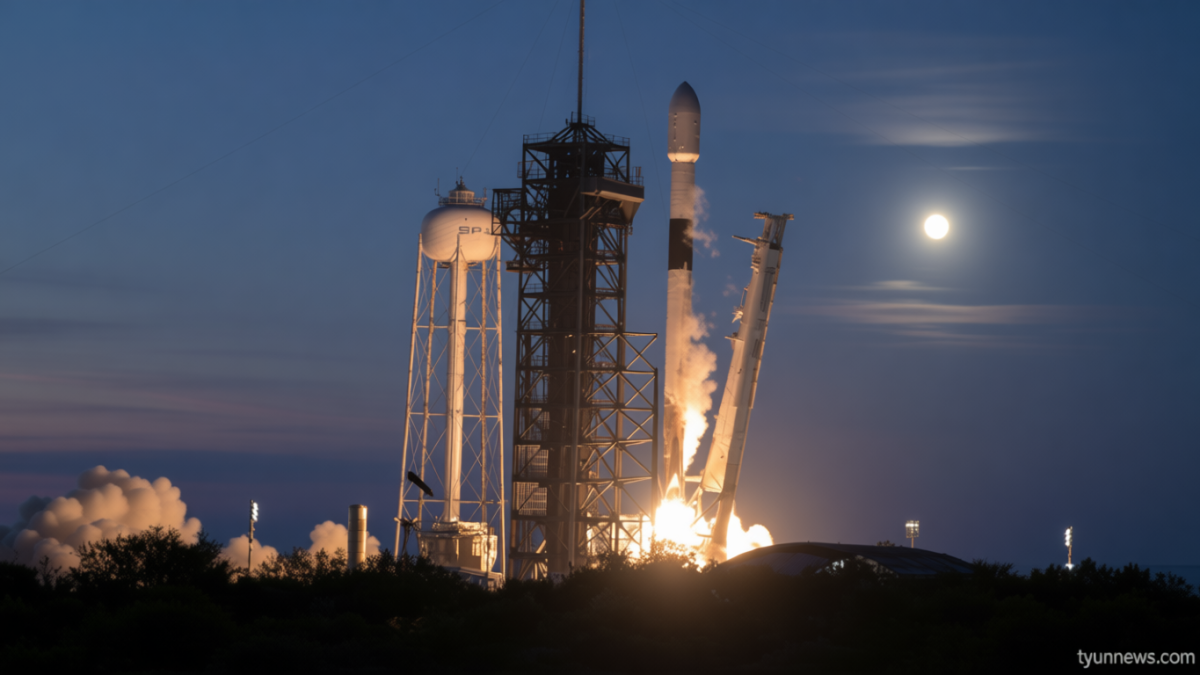
SpaceX Rocket Stage Set for Unplanned Lunar Collision
Tyunews.com – A discarded upper stage from a SpaceX Falcon 9 rocket is preparing to make an unexpected journey to the moon’s surface. Weighing approximately five tons, this component originally helped transport two lunar landers to the satellite. While not part of any planned mission, the stage will arrive at the moon on Aug. 5 at approximately 2:34 a.m. ET, smashing into the surface at 5,400 miles per hour near the Einstein crater on the western edge of the lunar face.
Bill Gray, who operates Project Pluto and creates tracking software for celestial objects, was the first to determine the collision would occur and has monitored the trajectory since. He subsequently collaborated with an international research group on a study examining the impending impact. Their findings were published on the open-access preprint server arXiv, though the paper has yet to undergo peer review.
Scientific Opportunity for Lunar Research
Benjamin Fernando, a postdoctoral researcher at Los Alamos National Laboratory in New Mexico and lead author of the study, explained what scientists anticipate witnessing. “We expect that to vaporize the booster, create a flash of light, probably a plume of ejecta — dust, regolith, other stuff mixed into it — and of course excavate a fresh crater on the lunar surface,” he told ABC News.
The collision presents researchers with a valuable chance to refine their methods. Fernando noted that while meteoroid strikes on the moon occur regularly, determining the mass and velocity of these natural objects proves challenging. “Because the researchers know those two variables for the upper stage, they can use the impact as a ‘calibration event to test all of the techniques that we use for studying natural impacts, which we don’t know are going to happen in advance, unlike this event,’ according to Fernando.”
Additionally, the plume generated by the impact could reveal information about the moon’s composition. “If we can measure the composition of that, that tells us something about the composition of that part of the moon,” Fernando explained.
Risks for Future Lunar Missions
With NASA targeting a return of astronauts to the moon as early as 2028 and plans for a permanent lunar base, understanding impact risks has become increasingly important. “These sorts of things are going to happen more and more often. And as we have more astronauts on the lunar surface, more lunar infrastructure habitats, for example, we need to understand how much of a risk these impact events actually pose,” said Fernando.
He continued, “This is an ideal way of studying both the direct risks, the risk of being hit by debris or being blinded by a flash of light, but also the indirect risk, the risk of being hit by a cloud of ejected material and having that disrupt or interfere with spacecraft functions in lunar orbit as well.”
Background on the Rocket Stage
On Jan. 15, 2025, SpaceX launched a Falcon 9 rocket carrying Firefly Aerospace’s Blue Ghost 1 lunar lander alongside ispace’s Resilience lander. Blue Ghost achieved a successful landing on March 2, 2025. Resilience, however, crashed onto the lunar surface after losing communication with the vehicle 90 seconds before touchdown.
During its mission, the Falcon 9’s upper stage “was abandoned in a moon-crossing high-Earth orbit,” researchers noted. The stage is now following a trajectory that will bring it to the moon’s surface.
Fernando expressed uncertainty about SpaceX’s awareness of the impending collision. “I don’t think we know from SpaceX exactly to what degree they were in the know that this was going to happen. Certainly, the fact that it was used to deliver hardware to the moon meant that it was probably left in an orbit where there was a possibility of this happening. Whether they knew that it was going to happen and didn’t say anything, or they simply hadn’t run the calculation, I couldn’t tell you,” he said.
For those hoping to witness the event, the flash will be too dim for unaided observation. A telescope is necessary, though success remains uncertain since no impact flash has ever been captured on the sunlit portion of the moon—precisely where this collision will occur. Fernando recommended that amateur astronomers point small telescopes toward the moon, as the research team is encouraging public observation of this unique celestial event.