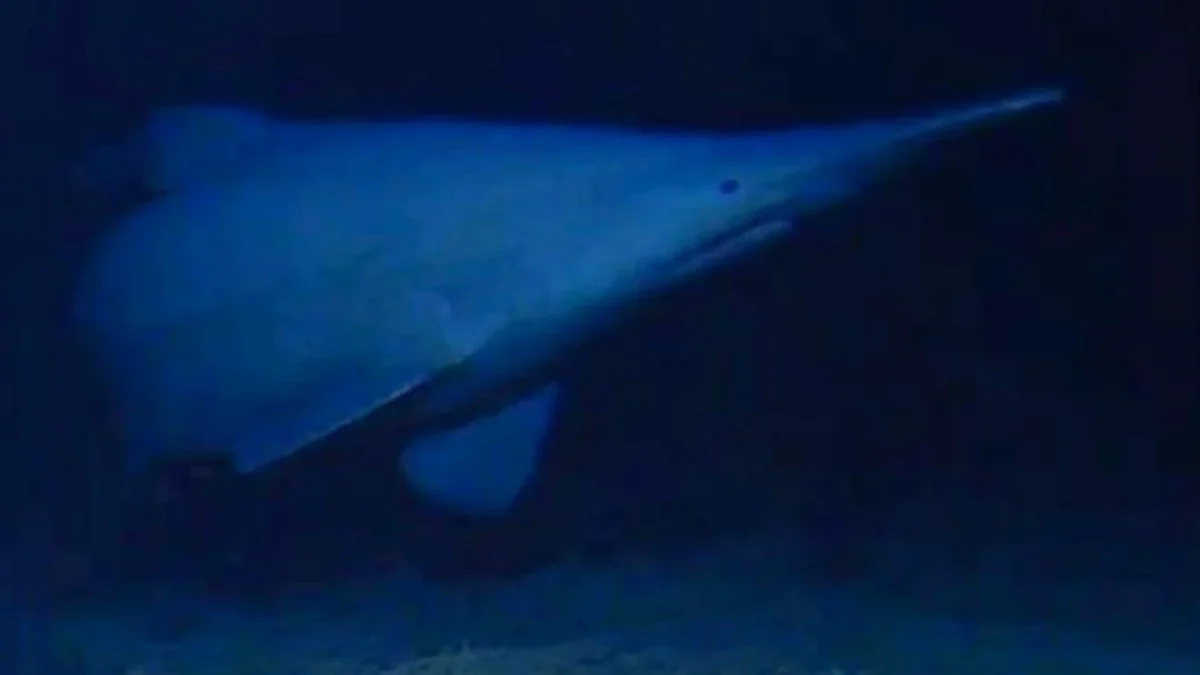
Rare Goblin Shark Filmed in the Wild for the First Time, Study Confirms
Tyunews.com – A groundbreaking moment in marine biology has arrived as researchers successfully captured video footage of the elusive goblin shark, a rare deep-sea species, in its natural habitat for the first time. This unprecedented discovery, detailed in a recent study published in the Journal of Fish Biology, marks a significant leap in understanding the behavior and ecology of one of the ocean’s most mysterious creatures. The footage, filmed in the wild, offers critical insights into the shark’s movements and feeding patterns, which have long been shrouded in scientific uncertainty.
Unique Characteristics of the Goblin Shark
The goblin shark, scientifically known as *Mitsukurina owstoni*, is a living relic of ancient marine life, with a lineage dating back over 125 million years. Its distinctive features, such as the elongated, horn-like rostrum and a jaw that can extend rapidly to capture prey, have earned it the moniker “living fossil.” These traits, combined with its pale, almost ghostly coloration, make the species both visually striking and scientifically intriguing. Dr. Aaron Judah, a PhD candidate at the University of Hawaii at Manoa, explained that the rostrum is not merely an aesthetic feature but houses specialized sensory organs called Ampullae of Lorenzini, which detect electrical signals in the water. This adaptation allows the goblin shark to locate prey such as squid, fish, and crustaceans in the dark, nutrient-scarce depths of the ocean.
“When we first saw the footage, it felt like we were witnessing a glimpse into a prehistoric world,” said Steve Auscavitch, a PhD scientist at the Smithsonian Institution’s National Museum of Natural History.
Despite its ancient origins, the goblin shark has remained elusive to scientists, with only a handful of observations recorded over the years. The first confirmed footage emerged in 2019, captured by an ROV (remotely operated vehicle) operated by the Ocean Exploration Trust. The video, taken near Jarvis Island—a remote coral atoll in the Pacific Remote Islands Marine National Monument—revealed the shark in a seamount area, a type of underwater mountain. This location, known for its rich biodiversity, has become a focal point for deep-sea exploration. Auscavitch noted that the team initially struggled to identify the creature, as its ghostly white or pinkish hue was unlike that of most sharks, which typically have more robust coloring.
Expanding the Known Range of the Species
Building on the 2019 discovery, a second sighting in 2024 further broadened the understanding of the goblin shark’s habitat. This time, the footage was captured using baited cameras in collaboration with the Minderoo-University of Western Australia Deep-Sea Research Center. The location, along the Tonga Trench’s slope, is approximately 1,250 miles southwest of Jarvis Island. This distance highlights the vast and varied environments where the species can thrive. The study now confirms that the goblin shark is present in the Pacific, Atlantic, and Indian Oceans, as noted by the International Union for Conservation of Nature (IUCN). Such findings are crucial for mapping the distribution of deep-sea species and addressing gaps in their ecological knowledge.
“This discovery underscores the importance of seamounts as hotspots for marine life,” said James Lea, CEO of the Save Our Seas Foundation.
The 2024 footage, which was filmed in the wild, provided valuable data on the shark’s behavior in its natural environment. Unlike previous observations, which often occurred in fisheries, this study emphasizes the need for in-situ research to capture the species in its native habitat. The goblin shark’s ability to adapt to such extreme conditions—low light, high pressure, and limited food sources—makes it a key indicator of the health of deep-sea ecosystems. By studying these creatures, scientists can better understand the delicate balance of life in the ocean’s depths and how human activities might impact it.
Experts believe that the goblin shark’s unique biology and low population density make it particularly sensitive to environmental changes. The first confirmed footage of the species in the wild has already sparked discussions about the need for more targeted conservation efforts. With deep-sea fishing expanding into unexplored regions, the goblin shark’s survival depends on protecting its habitats and reducing bycatch. The study’s findings, which are now peer-reviewed, provide a foundation for future research and policy decisions aimed at safeguarding this rare species.
The goblin shark filmed in the wild has redefined the way scientists approach deep-sea exploration. The use of advanced technology, such as ROVs and baited cameras, has allowed for the first time to observe the species without disrupting its natural behavior. This methodology, which is essential for studying elusive marine life, demonstrates the power of modern tools in uncovering hidden aspects of the ocean. As more footage of the goblin shark filmed in the wild becomes available, researchers hope to fill critical knowledge gaps and enhance conservation strategies. The rare goblin shark filmed in the wild is no longer a scientific curiosity but a vital part of marine biodiversity that demands attention and protection.